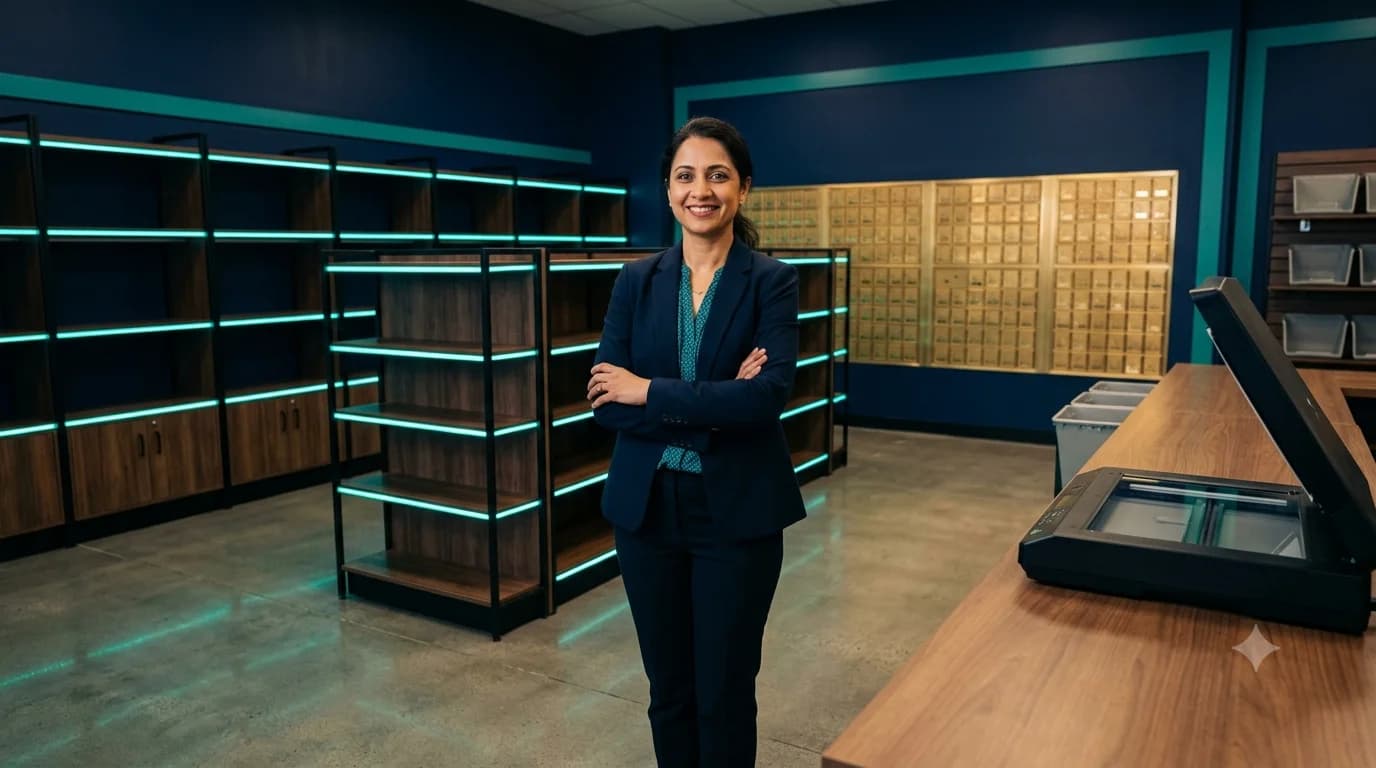
Mailbox services are one of the quieter opportunities in local business. Print shops, shipping stores, coworking spaces, business centres, and even notary offices all have the same underused asset: a staffed street address. Turning that address into a mail center, a place where individuals and businesses rent mailboxes and have their mail received, scanned, and forwarded, adds a recurring revenue stream to foot traffic you already have. This guide covers what mail center operators actually do, what the rules look like in the United States and Canada, and the practical steps to open one.
A mail center operator runs a physical location that receives mail and packages on behalf of customers. The day-to-day work is straightforward: accept deliveries from carriers, log each item to the right customer, and then act on the customer's instructions. Depending on the services you offer, that can mean holding mail for pickup, opening and scanning it so the customer reads it online, forwarding it to another address, shredding what the customer discards, or receiving packages that a courier would otherwise not leave at an unattended home.
In industry terms, a business that receives mail for others is a Commercial Mail Receiving Agency, or CMRA. If you want the customer-side view of the model you are entering, our guide on what a CMRA is explains how renters evaluate providers, which is useful competitive homework for a future operator.
Three characteristics of the business make it attractive as an add-on rather than a from-scratch venture. It is recurring: mailbox rentals bill monthly, unlike one-off print or shipping jobs. It is space-efficient: a wall of mailboxes and a secure shelf area produce revenue from square footage that rarely earns its keep. And it compounds with your existing traffic: every renter who visits for a pickup walks past your other services. None of this makes it effortless, you are taking custody of other people's mail and that responsibility is the product, but it explains why so many mail centers grow inside existing storefronts rather than as standalone shops.
The US regulates commercial mail receiving formally, through the USPS. If your location is in the United States, becoming a CMRA involves a specific registration path:
Register with your local Post Office. The owner or manager files PS Form 1583-A with the postmaster responsible for your delivery area. This registers the business as a CMRA and must be kept up to date: if the information on the form changes, a revised form needs to be filed.
Collect authorization from every customer. Each customer who receives mail at your address completes PS Form 1583, which authorizes you to accept mail on their behalf and documents their identity. You are required to keep a current form on file for every active customer.
Maintain records in the USPS system. CMRAs enter customer registrations into the USPS customer registration database and complete periodic compliance certifications. Post offices can verify that mail arriving at your address matches customers with valid forms on file.
Address format matters. Customer addresses at a CMRA are private mailboxes and are expected to be identified as such, with a PMB designation or number sign, rather than presented as office suites.
The authoritative source for all of this is the USPS, and requirements are set out in the Domestic Mail Manual's section on commercial mail receiving agencies. Build your process from the current USPS requirements rather than from summaries, including this one.
Canada takes a lighter-touch approach. There is no Canada-wide registration equivalent to the USPS CMRA process, no national form your customers must file with the postal service, and no federal license specific to receiving mail for others. What applies instead is the ordinary machinery of running a business, plus privacy law:
Business basics. Register your business or corporation in your province, hold a municipal business licence where your city requires one, and check that your zoning and lease allow a mail receiving service at the location.
Privacy obligations. Handling other people's mail means handling their personal information. Canadian privacy law places real obligations on businesses that collect and store personal information: safeguard it, use it only for the service, and be able to answer for how it is handled. Secure storage, controlled access to customer mail, and a clear retention and shredding process are not just good service, they are your compliance posture.
Carrier relationships. Confirm your location can receive deliveries from all major carriers, and understand each carrier's rules for accepting items on behalf of third parties, including signature items.
The absence of a single registration regime does not mean the bar is lower. Customers are trusting you with government letters, cheques, and legal documents. Operators who treat identity verification and chain of custody as seriously as US rules require, even where not federally mandated, run better businesses and win the commercial clients that make mailbox revenue meaningful.
The physical requirements are modest, which is what makes this work as an add-on:
1. A staffed street address with reliable business hours, since the entire value of a mail center is that someone is present to receive and secure deliveries.
2. Secure storage: lockable mailboxes or shelving for held mail, and a separate secure area for packages.
3. A document scanner capable of clean, fast scans, since scanning is the service that turns a local mailbox into a virtual one customers can use from anywhere.
4. A process for identity verification at signup, so every box maps to a documented person or business.
5. Software to run it all, which is the piece most new operators underestimate. Logging items, notifying customers, taking scan and forwarding requests, billing subscriptions, and keeping an audit trail is a full software product, not a spreadsheet.
You have three options for the operating layer. Building your own is realistic only if software is your core business. Buying standalone mailbox software gets you tools, but leaves you alone on pricing, payments, and customer acquisition. The third model is joining an operator platform, where the software, payments, and a customer-facing marketplace come as a package and you focus on the physical operation.
This is the model C-Band Mailbox runs. Operators join the platform, list their location, and get the full operating stack: a dashboard for receiving and logging mail, scanning workflows, customer notifications, billing, and renter-facing apps their customers use to read and manage mail. You set your own plans and your own pricing for your location, there are no franchise fees, and your location gets a public page on the platform where renters searching your area can sign up. The details, including operator guides and the application form, are on our mailbox center page, and you can start an application directly at become an operator.
Pulling it together, here is the order that works:
1. Validate the location. Confirm zoning, lease terms, and carrier access for mail receiving at your address.
2. Handle registration. In the US, file PS Form 1583-A with your postmaster and set up your Form 1583 process. In Canada, confirm business registration, licensing, and your privacy practices.
3. Set up the physical plant. Mailboxes or shelving, secure package area, scanner, and a defined intake station.
4. Choose your operating layer. Platform, standalone software, or build. Decide before opening, migrating customers later is painful.
5. Define plans and pricing. Decide what tiers you offer, what is included, and what is pay-per-use, informed by what locations like yours charge in your market.
6. Open with a compliance file. From day one, keep identity records, custody logs, and shredding records as if you will be audited, because the day a legal document goes missing is the day you will wish you had.
A mail center will not transform a storefront overnight, and anyone promising specific revenue numbers is guessing. What it offers is a durable, subscription-based service line built on an asset you already pay for: a trustworthy address with a person behind it. If that matches your location, the path above is how you start.